Archives for category: writing

The Way of Unsaying

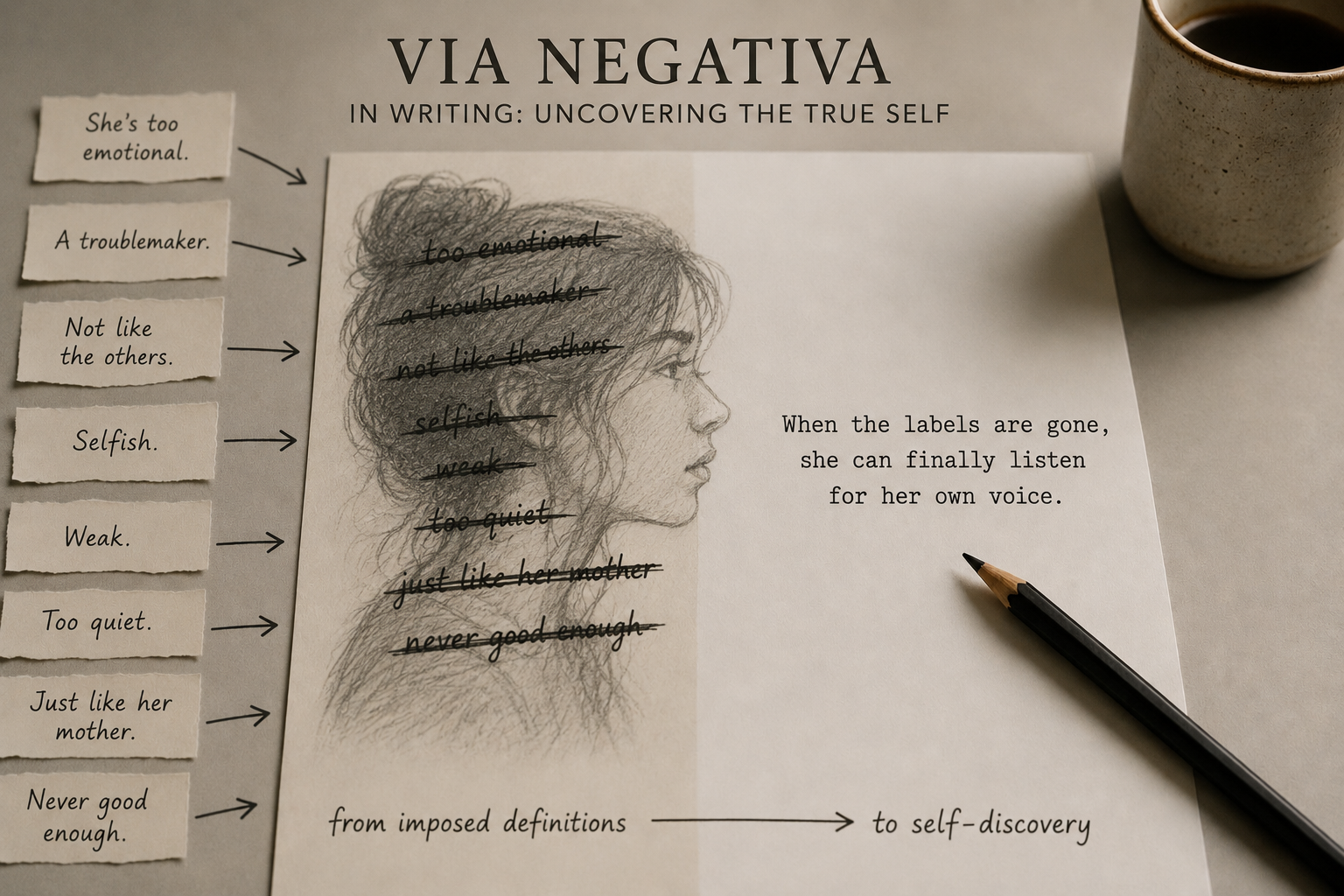
Via negativa, “the negative way”, is the name for a specific method of approaching truth (traditionally, the truth of God, but the method outlives its original target) by systematically denying every positive statement you might make about it, rather than by accumulating positive descriptions. Its formal name in theology is apophatic theology and it stands opposite cataphatic theology, which proceeds the more familiar way: God is good, God is powerful, God is loving, building a positive picture claim by claim.

The apophatic method, takes assertions away. You say that God is NOT good, not because God is bad, but because God is so much bigger than the meaning of the word “good.” By describing them, humans put people in a box. The Via negativa strips away one description at a time until you aren’t confined by the box any more.

Saint John of the Cross, the sixteenth-century Spanish Carmelite, gave the tradition its most famous experiential account in The Dark Night of the Soul. This phrase should sound familiar to writers, but how he used it is a technical description of a stage in which God deliberately withdraws every consolation, every felt sense of divine presence, precisely so the soul stops mistaking its own feelings and images about God for God, and can be purified toward a union no longer dependent on any positive experience at all. His formula todo y nada, “everything and nothing”, captures the paradox at the method’s center: the way to everything is through nothing; the fullness is reached by way of complete emptying. When you strip everything away, you don’t find nothing. You find the truth.

Via Negativa in Literature

The clearest place the method crosses fully and explicitly into secular literature is T. S. Eliot’s Four Quartets, particularly the third movement of “East Coker,” which is close to a versified paraphrase of John of the Cross:

In order to arrive there, / To arrive where you are, to get from where you are not, / You must go by a way in which there is no ecstasy. / In order to arrive at what you do not know / You must go by a way which is the way of ignorance. / In order to possess what you do not possess / You must go by the way of dispossession.

Samuel Beckett offers a very different, more secular literary extreme of the same instinct, paring down toward silence, not to arrive at God, but seemingly to arrive at whatever remains of a person or a truth once every consoling fiction about them has been subtracted. “Fail better” is very nearly a version of todo y nada with the theology removed: the only way forward is through successive, deliberate diminishment.

The Via Negativa and Alchemy

Alchemy uses the term solve et coagula, which is when the base substance is broken down, often by an external agent (fire, acid, decay) that the material does not choose and cannot resist. It is closer, in narrative terms, to what a plot does to a character: circumstance dissolves the old identity, often against the character’s will.

Via negativa, by contrast, is characteristically a practice, something a person does, deliberately and repeatedly, as a discipline of subtraction performed on their own assumptions, attachments, and self-images. Where alchemical dissolution can be violent and involuntary, the negative way is (at least in its classical form) chosen: the mystic renounces images of God one at a time, on purpose, as an act of will and humility, rather than having them stripped away by force.

In a book, character can be solve-broken by what the plot does to them (betrayal, loss, exile, violence they didn’t choose). Or a character can walk a via negativa, actively, on their own initiative, refusing each false identity offered to them, denying each name that doesn’t fit, even when accepting it would be easier and safer. The most durable versions of a stripped-down identity arc often use both: the world forces the dissolution (solve), and the character’s own repeated, deliberate refusals (via negativa) are what keep the dissolution from collapsing into mere victimhood. The refusal is what makes the stripping an act of the character’s own agency rather than something that was simply done to them.

An Identity Arc

The apophatic insight, that the truest thing about a subject cannot be reached by adding more positive descriptions, only by peeling away the false ones, maps unusually cleanly onto the literary problem of a character who has been over-defined by other people’s names for them. A character who has been called “the problem,” “a pawn,” “a servant,” “a pet,” “a queen,” “a sacrifice” by everyone around her is, in apophatic terms, buried under cataphatic assertions made by other people. She is defined by the outside. As she strips these assertions away, she gets closer to finding out who she is all on her own. The self-naming, when it finally arrives, is very quiet. The soul simply arrives, and it stops needing a description.

As you write, ask whether the refusals are the character’s own acts rather than things that merely happen to her. Genuine apophatic structure denies one named thing at a time. It is a discipline, not a demolition.
Most writing advice will eventually point you toward the Hero’s Journey. But there’s another, older structure, and it doesn’t center on conquest. Its center is transformation. It comes from anthropology and ritual theory, and it pairs really well with shamanic thinking.

Now here’s the disclaimer, I’m not a shaman, of course. It’s a long road to become one, and most of us weren’t born with the right cultural context to even walk that path. But I love reading about it, because it provides a wonderful framework to make sense of so many things. I hope that I’m learning from wisdom and not trying to appropriate a gift that was not in my heritage.

If you’re writing a novel about hidden truths, shifting identities, or magical revelation, this framework might feel more natural: 

  • Van Gennep’s three-part ritual structure: separation, liminality, incorporation
  • Victor Turner’s expansion: liminality as a space of ambiguity, anti-structure, and communitas
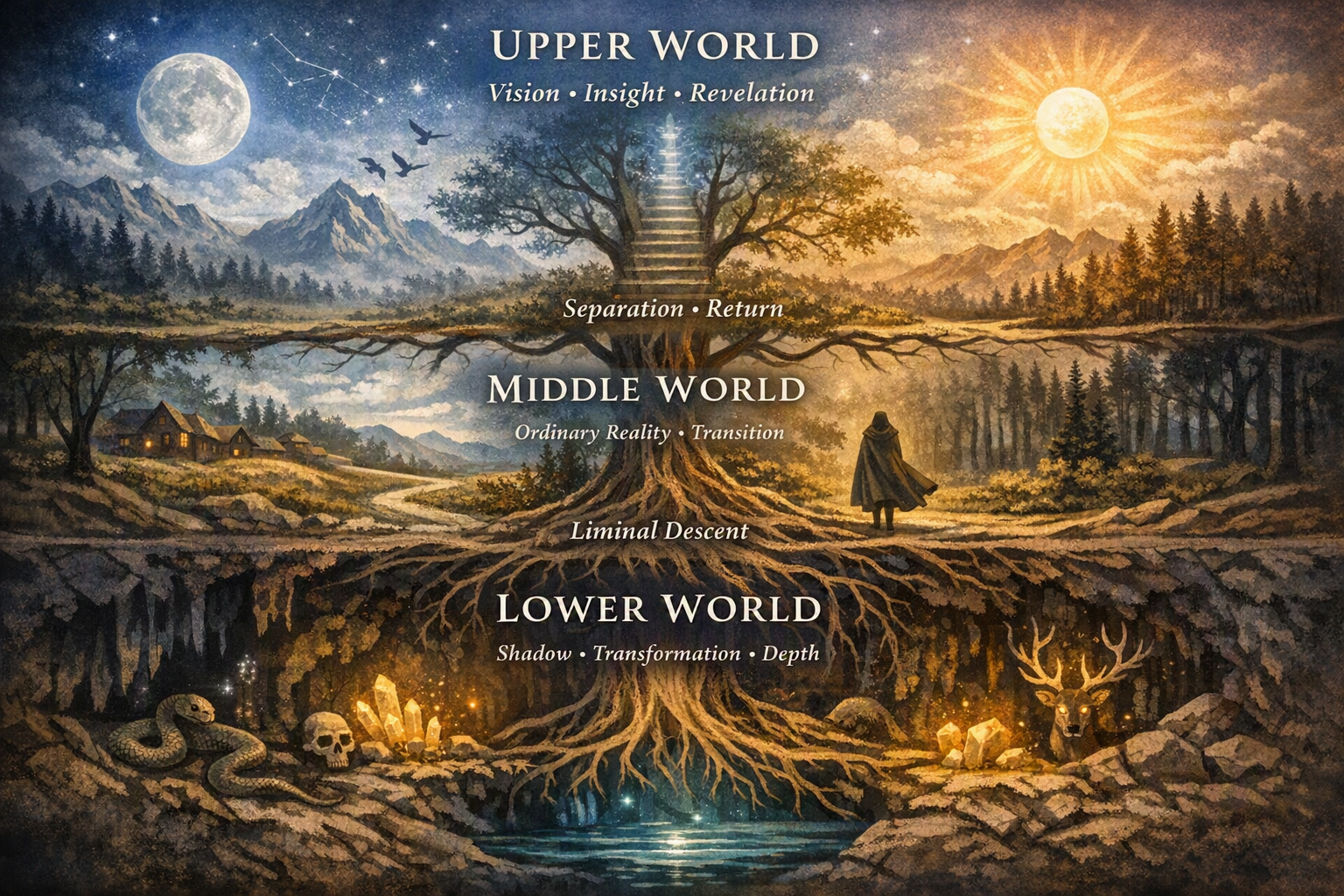
  • Shamanic cosmology: upper world, middle world, lower world

Together, they offer a useful way to think about narrative as an initiation rather than as a quest. (Quest are great too. I love a good quest. But not all stories are about quests.)

As Victor Turner expanded Van Gannep’s work, he highlighted that the middle phase, liminality, is key. It is a space of “betwixt and between,” where identity dissolves, hierarchy collapses, and new possibilities emerge. In this space, characters (and people) may experience communitas, a raw, equalizing connection that transcends normal structure. 

The Three Worlds as Narrative Space

Shamanic traditions describe reality as layered into three interconnected realms: 

  • Lower World – descent, instinct, memory, transformation
  • Middle World – ordinary reality, relationships, lived experience
  • Upper World – insight, meaning, vision, transcendence

These worlds are not separate locations so much as modes of perception. The shaman moves between them to bring back knowledge, healing, or power. 

So can the main character in your book.

Mapping the Three Worlds onto Ritual Narrative

Instead of mapping plot beats, think in terms of ritual movement through worlds. 

I. Separation: Leaving the Middle World

Every story begins with a break from the ordinary, which is why you start with the ordinary world that the character is familiar with. It doesn’t have to be good. But it’s working one way or another. (It might be that your identity is defined by someone else, you’re miserable, etc., but you’re used to it. The boat might be sad but not rocking.)

In ritual terms, separation removes the initiate from this structure. They are stripped of certainty, often through loss, disruption, or invitation. In the three-act structure, this is the inciting event.

II. Liminality: Descent and Ascent (Lower and Upper Worlds)

This is the heart of your novel. Turner describes liminality as a state of ambiguity where old identities dissolve and new ones have not yet formed. It is unstable, disorienting, and creative. In shamanic terms, this phase often involves movement between the Lower and Upper Worlds: 

The Lower World: Descent into the Hidden is where the protagonist descends. It’s not “hell,” it’s the realm of instinct, memory, trauma, animal knowing, and transformation. 3

In a story, it’s when you have to confront your shadow. You might even literally enter into an underworld. You’ll probably have to face buried truths. The Lower World strips away illusion. It is where the character encounters what has been hidden by others or by themselves. 

The Upper World is the ascent into meaning. After you deal with your shadow work (there’s a lot of psychology going in in here in case you didn’t notice), comes ascent to the upper world. This is where you find vision, insight, reframing, and contact with something larger like ancestors or Truth.

This is the place where you can see the patterns at last, where it makes sense, where you are heading for the “You have no power over me” kind of climax.

Liminality as Anti-Structure

During this middle phase, normal rules break down. 

Turner calls this anti-structure—a suspension of hierarchy and order where new forms can emerge. 

In your novel, this might look like Social roles reversing, or outsiders becoming guides, or the power is just shifting unpredictably.

This is also where communitas can form: unexpected bonds between characters who meet outside the constraints of ordinary identity. These relationships often feel more real than those in the “normal” world, and they are key to transformation. 

III. Incorporation: Returning to the Middle World

In the hero’s journey there is a victory before the hero returns to the community. In ritual, it’s much more about the change, and often there is no physical victory. Who you are, how you see the world is different. Van Gennep calls this reaggregation, re-entering society with a new status. 

The world may look the same, but it is not. You have different knowledge (power, truth, etc.), and you can’t go back to your earlier life. The difference is when the theme is about hidden identities (changelings, shapeshifters), secret truths and revelations, psychological or spiritual descent, nonlinear or dreamlike storytelling. So much more internal than external. I mean, in Campbell, there’s an internal too, but the plot and the action drive the story forward. Here, we have gates or thresholds that move us from one phase of the story to the next.

Because the story is about liminality, it’s a great structure if you want any ambiguity, instability, or multiplicity of self.

The Writer as Shaman

In this model, the writer is guiding a ritual. Think about it, you lead the reader out of the ordinary, hold them in ambiguity, and then bring them back changed. Together, you move between worlds.