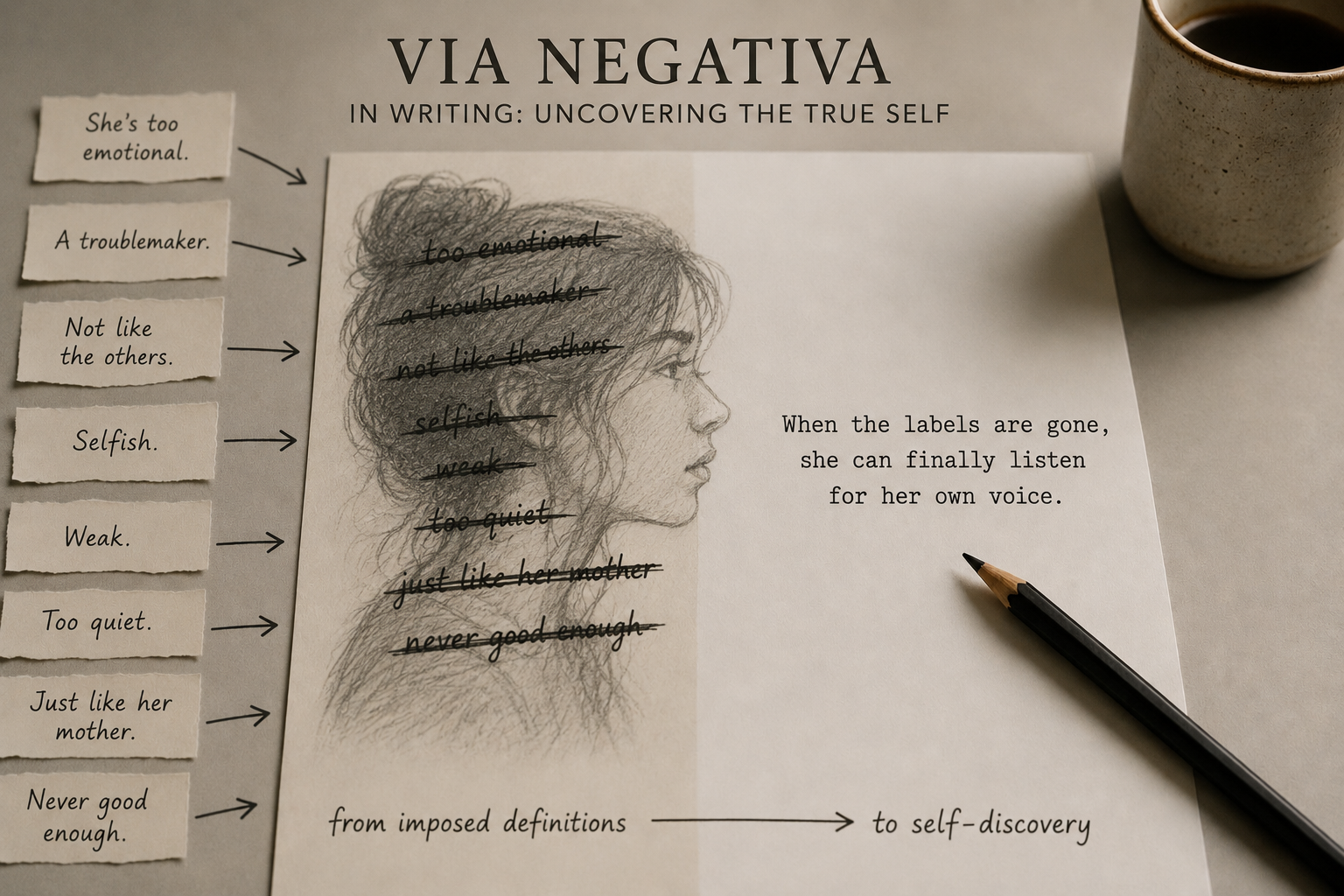
The Way of Unsaying
Via negativa, “the negative way”, is the name for a specific method of approaching truth (traditionally, the truth of God, but the method outlives its original target) by systematically denying every positive statement you might make about it, rather than by accumulating positive descriptions. Its formal name in theology is apophatic theology and it stands opposite cataphatic theology, which proceeds the more familiar way: God is good, God is powerful, God is loving, building a positive picture claim by claim.
The apophatic method, takes assertions away. You say that God is NOT good, not because God is bad, but because God is so much bigger than the meaning of the word “good.” By describing them, humans put people in a box. The Via negativa strips away one description at a time until you aren’t confined by the box any more.
Saint John of the Cross, the sixteenth-century Spanish Carmelite, gave the tradition its most famous experiential account in The Dark Night of the Soul. This phrase should sound familiar to writers, but how he used it is a technical description of a stage in which God deliberately withdraws every consolation, every felt sense of divine presence, precisely so the soul stops mistaking its own feelings and images about God for God, and can be purified toward a union no longer dependent on any positive experience at all. His formula todo y nada, “everything and nothing”, captures the paradox at the method’s center: the way to everything is through nothing; the fullness is reached by way of complete emptying. When you strip everything away, you don’t find nothing. You find the truth.
Via Negativa in Literature
The clearest place the method crosses fully and explicitly into secular literature is T. S. Eliot’s Four Quartets, particularly the third movement of “East Coker,” which is close to a versified paraphrase of John of the Cross:
In order to arrive there, / To arrive where you are, to get from where you are not, / You must go by a way in which there is no ecstasy. / In order to arrive at what you do not know / You must go by a way which is the way of ignorance. / In order to possess what you do not possess / You must go by the way of dispossession.
Samuel Beckett offers a very different, more secular literary extreme of the same instinct, paring down toward silence, not to arrive at God, but seemingly to arrive at whatever remains of a person or a truth once every consoling fiction about them has been subtracted. “Fail better” is very nearly a version of todo y nada with the theology removed: the only way forward is through successive, deliberate diminishment.
The Via Negativa and Alchemy
Alchemy uses the term solve et coagula, which is when the base substance is broken down, often by an external agent (fire, acid, decay) that the material does not choose and cannot resist. It is closer, in narrative terms, to what a plot does to a character: circumstance dissolves the old identity, often against the character’s will.
Via negativa, by contrast, is characteristically a practice, something a person does, deliberately and repeatedly, as a discipline of subtraction performed on their own assumptions, attachments, and self-images. Where alchemical dissolution can be violent and involuntary, the negative way is (at least in its classical form) chosen: the mystic renounces images of God one at a time, on purpose, as an act of will and humility, rather than having them stripped away by force.
In a book, character can be solve-broken by what the plot does to them (betrayal, loss, exile, violence they didn’t choose). Or a character can walk a via negativa, actively, on their own initiative, refusing each false identity offered to them, denying each name that doesn’t fit, even when accepting it would be easier and safer. The most durable versions of a stripped-down identity arc often use both: the world forces the dissolution (solve), and the character’s own repeated, deliberate refusals (via negativa) are what keep the dissolution from collapsing into mere victimhood. The refusal is what makes the stripping an act of the character’s own agency rather than something that was simply done to them.
An Identity Arc
The apophatic insight, that the truest thing about a subject cannot be reached by adding more positive descriptions, only by peeling away the false ones, maps unusually cleanly onto the literary problem of a character who has been over-defined by other people’s names for them. A character who has been called “the problem,” “a pawn,” “a servant,” “a pet,” “a queen,” “a sacrifice” by everyone around her is, in apophatic terms, buried under cataphatic assertions made by other people. She is defined by the outside. As she strips these assertions away, she gets closer to finding out who she is all on her own. The self-naming, when it finally arrives, is very quiet. The soul simply arrives, and it stops needing a description.
As you write, ask whether the refusals are the character’s own acts rather than things that merely happen to her. Genuine apophatic structure denies one named thing at a time. It is a discipline, not a demolition.

