What happens next?
Many stories ask this question. Possibly even most stories ask this question. Think of your thrillers, your page-turners, your beach reads—but sometimes deeper things too. We want to rush to the end. The sequence, the clock, the progression pushes us forward.
Now think of about rituals.
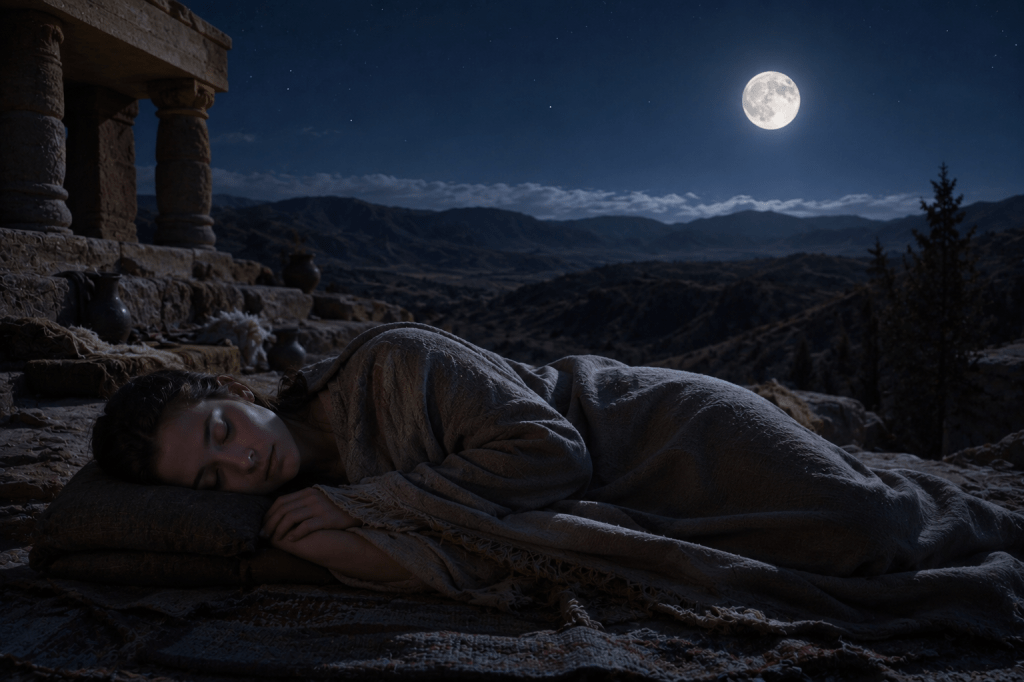
They center around things like the moon, the sun, the harvest, the seasons, life stages. These things don’t move forward at all. In fact, some of the things that make ancient civilizations the most sympathetic to me, anyway, are those natural (nature-based) and human things that have nothing to do with progress and everything to do with return. A Roman baby bottle made of terracotta has a blessing on it to (we can only hope) prevent breakage. A girl sleeps in the right place under the right sky to dream of her future husband. An early Icelander (aka Viking) places an object with a rune on it and ties it to a woman’s thigh to protect during childbirth. I can understand these things, these rituals.
The moon has been young for a very long time.
Ritual is a place we return to, but here’s the thing, it’s not redundant or boring. It’s liminal, because each time, it’s not the actions that change, it’s the meaning.
Enter Lord of the Rings.
Remember how Frodo takes a little jaunt out hiking at night, but then he finds a place to rest at Farmer Maggot’s and again at Crick Hollow and again at the Prancing Pony? Come to think of it, Rivendell and Lothlorien are also places where our heroes rest after adventures, after times of stress. If you drew the book, it would be one long stretched Slinky toy. We go off, we encounter danger and stress, and then we get somewhere safe. But for people who like the book, it’s not boring. Why? Because those times of rest and release aren’t doing nothing. They’re not a vacation or a spa. They’re a time of meaning-making where we reflect on what we just went through.
Lothlorien
This is probably the most poignant liminal time of rest and release in the story. (Don’t worry, if you have a different scene you’d fight for, I’d listen to you. But Lothlorien is still a good one.)
What’s just happened? Big stuff. They went through the mines of Moria where they found Balin’s tomb. (If you love The Hobbit, this was pretty emotional.) They almost got lost. Frodo was sort of impaled by a spear. They get chased by a mass of orcs. And then the Balrog. If you know your lore, you know that these guys are trouble. So much trouble that this one kills Gandalf.
The whole party is exhausted and ruined by grief.
So, Aragorn takes them to his (very nearly) grandmother-in-law’s house. Galadriel. And basically, nothing happens. They talk. They eat. They sit around and rest.
Except that this is where they are all tested. This is where the seeds of Boromir’s betrayal are planted. Frodo and Sam learn about the enemy and see what Galadriel would have become if she had taken the Ring. It’s actually a busy, busy section, but only in their hearts, minds, and souls. They reevaluate everything that has gone before, and it takes on new meaning. The Ring was dangerous, sure. But now Sam knows that it is directly tied to the future of the Shire in a very real way. Frodo begins to understand the Enemy at a new level.
Can you describe The Lord of the Rings using Campbell’s Hero’s Journey? Sure. It has the right stuff:
· Call to adventure
· Refusal/hesitation
· Crossing the threshold
· Trials
· Descent into darkness
· Return
Except that at the end, there is no victory, at least, not for Frodo. He is gradually transformed, wounded, diminished, and altered. The story’s central question not about conquering the villain. The story asks, “What happens to a person who bears this burden?”
Now let’s look at how it maps to a ritual narrative structure:
Separation (from the Shire and from an innocent worldview)
Liminality (This is the whole middle of the book. They are constantly having who they are stripped away and are reevaluating what things mean. Not just Frodo—but he is extremely stripped of his identity by the time he reaches Sammath Naur. As in, that’s the whole point of the book: he’s not Frodo anymore, he’s been taken over by the Ring.)
Return (The Shire is changed forever. So is Frodo.)
That liminality section is pretty vague and big. How does it work? Repetition. Stress and release. We do the same pattern, but it means something new each time.
First Repetition
At Bree and Weathertop: Can I resist putting on the Ring? Barely.
Second Repetition
At Rivendell and afterward: Can I carry this burden? Maybe.
Third Repetition
At Amon Hen: Must I carry it alone? The question deepens. The answer is both yes and no.
Fourth Repetition
The Dead Marshes: The burden is now psychological and spiritual. What is the Ring doing to Frodo? Nothing good.
Fifth Repetition
Shelob: The burden becomes suffering and death. Will Frodo fail? Yes. (Note on this: Another time we can talk about eucatatstrophy in Tolkien, but for now, just know that Tolkien’s philosophy is that we are all fallen and doomed to a tragic end, BUT you keep going anyway because it leaves the door open for a miracle. That’s how he answers some of the Christian conundrums between salvation and works.)
Sixth Repetition
Mount Doom: The question finally reaches its center. Can any creature possess absolute power and willingly surrender it? No. No they can’t. Not even Frodo can do it. But enter eucatastrophy and salvation both in spite of and because of doing all we can do.
So, Tolkien sets up these repetitions through stress and release patterns that keep spiraling through. They circle around the question of the Ring again and again, not pushing forward, but taking something big and complex and looking at it through different lenses.
Some of the stress and release moments:
Old Forest → Tom Bombadil
Weathertop → Rivendell
Moria → Lórien
Helm’s Deep → Isengard
Shelob → Field of Cormallen
Tolkien repeatedly allows recovery after crisis. This sometimes frustrates readers expecting plot-driven pacing. But from a ritual perspective, it makes perfect sense.
There are lots of reasons why The Lord of the Rings feels like an old book that comes from tradition rather than one author. One of those is that a plot-driven narrative is not always how stories were constructed in old stories.
Circles and spirals feel old to us because they are. As old as the moon. But not all moons mean the same thing. Rituals help us to know what the moon means for us now and helps us change what the moon means on another night.
That’s the kind of story that a ritual narrative structure tells. And honestly, that’s my kind of story.
 noellecarter